
Need civil papers delivered to the U.S. Attorney’s Office in Columbus? Put RVB Services, LLC on the local service assignment. Attorneys, paralegals and legal assistants can upload the issued papers and instructions or call 740-936-7625. Tell us which part of the federal service plan you need handled so the local delivery stays coordinated with the rest of your case.
Serving the United States can involve several recipients and different delivery methods. A completed Columbus assignment should not leave your team wondering whether someone also handled the required Washington mailing or a separate agency packet.
Start with the defendant and the capacity
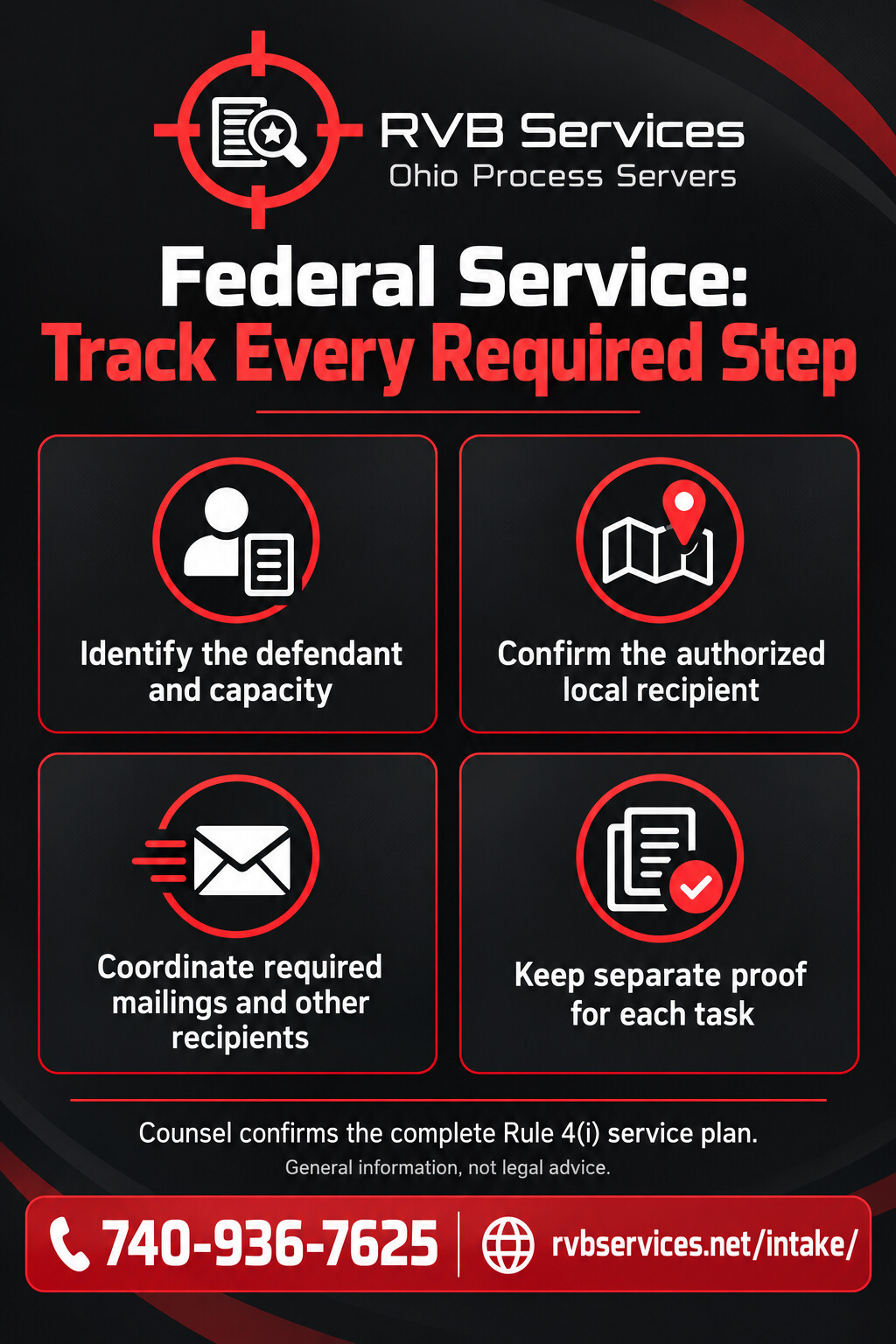
Have counsel identify whether the assignment concerns the United States, a federal agency or corporation, an official-capacity defendant, or an employee sued individually. Those details belong in the instructions, not just somewhere in the complaint. A short recipient list helps the person coordinating service track each required step without treating every federal defendant the same way.
Under Federal Rule of Civil Procedure 4(i), service on the United States includes the U.S. Attorney for the district where the action was brought and a registered or certified mailing to the U.S. Attorney General in Washington, D.C. The local component permits delivery to the U.S. Attorney or an assistant or clerical employee designated in writing filed with the court clerk, or registered or certified mail to the office’s civil-process clerk. Additional recipients depend on the action and defendant, including agency and individual-capacity requirements.
Ask counsel to specify the complete service plan. RVB’s assignment should identify the authorized local task and who is handling every remaining recipient.
Confirm the Columbus office and acceptance arrangements
The Southern District of Ohio U.S. Attorney’s official contact page lists the Columbus main office at 303 Marconi Boulevard, Suite 200, Columbus, OH 43215, with main number 614-469-5715.
That listing establishes a current office contact, not a blanket authorization for any person in the lobby to accept service. Before a hand-delivery assignment, confirm the current acceptance procedure and the intended recipient’s authority. Include any relevant written designation, court direction or office instructions with the assignment. Building access, a reception desk and an authorized service recipient are separate practical questions.
Also confirm that the Southern District of Ohio is the correct district for the local component. An Ohio witness or agency address does not, by itself, establish where the underlying federal action was brought.
Give each recipient a separate tracking entry
For a coordinated federal assignment, send a cover sheet showing the recipient, the documents intended for that recipient, the selected method, the responsible person and the requested completion date. Keep the issued summons and complaint matched to the correct defendant. Label any agency copies clearly.
If your firm is handling the Washington mailing, say so. If another vendor is serving an individual defendant, identify that as a separate task. Ask for the documentation you need from RVB without expecting a local return to document someone else’s mailing or delivery.
Keep state service and subpoenas separate
The Ohio Attorney General and the Attorney General of the United States are different offices. Do not route a federal Rule 4(i) assignment to the state office because both appear in a contact list under “Attorney General.” Federal subpoenas also require a separate review under Rule 45 rather than a summons-and-complaint checklist. Identify the document type before arranging delivery.
Frequently asked questions
Does delivery to the Columbus U.S. Attorney’s Office complete service on the United States?
Usually that is only the local part of the service plan. Rule 4(i) also requires service on the U.S. Attorney General in Washington, D.C., and may require additional agency or individual service. Have counsel identify every recipient and assign responsibility for each step.
Which U.S. Attorney’s Office should receive the local service packet?
Rule 4(i) looks to the district where the action was brought. Do not choose Columbus solely because a defendant or witness is in Ohio. Confirm the district and the office’s acceptance procedure before dispatching the packet.
Is the Ohio Attorney General the same recipient as the U.S. Attorney General?
No. They are different offices. The federal Rule 4(i) requirement refers to the Attorney General of the United States in Washington, D.C. A delivery to the Ohio Attorney General does not substitute for that federal service step.
What does RVB need to price and coordinate a Columbus delivery?
Send the issued papers, district and case number, intended recipient, service method, deadline and return requirements. Identify who is handling any Washington mailing or additional agency packets. We will confirm the scope and price of the accepted local assignment rather than treating one Columbus delivery as the entire federal service plan.
Send the local assignment to RVB
Include the complete papers, district and case number, recipient instructions, deadline, acceptance information and return requirements. We can discuss the local service assignment while your legal team retains responsibility for the governing requirements and remaining steps.
Start your RVB service request or call 740-936-7625. For a broader look at document types, see What Legal Documents Can an Ohio Process Server Serve?
Legal disclaimer
This article is for general information and reference, not legal advice. RVB Services, LLC is a process-serving business, not a law firm; reading this article or contacting us does not create an attorney-client relationship. Information, laws, rules and procedures can change, so confirm current requirements with the appropriate court or agency. We do not guarantee the information is complete or current, accept responsibility for losses from reliance on it, or guarantee any legal outcome or court acceptance. For advice about your situation, consult an attorney licensed in your jurisdiction.